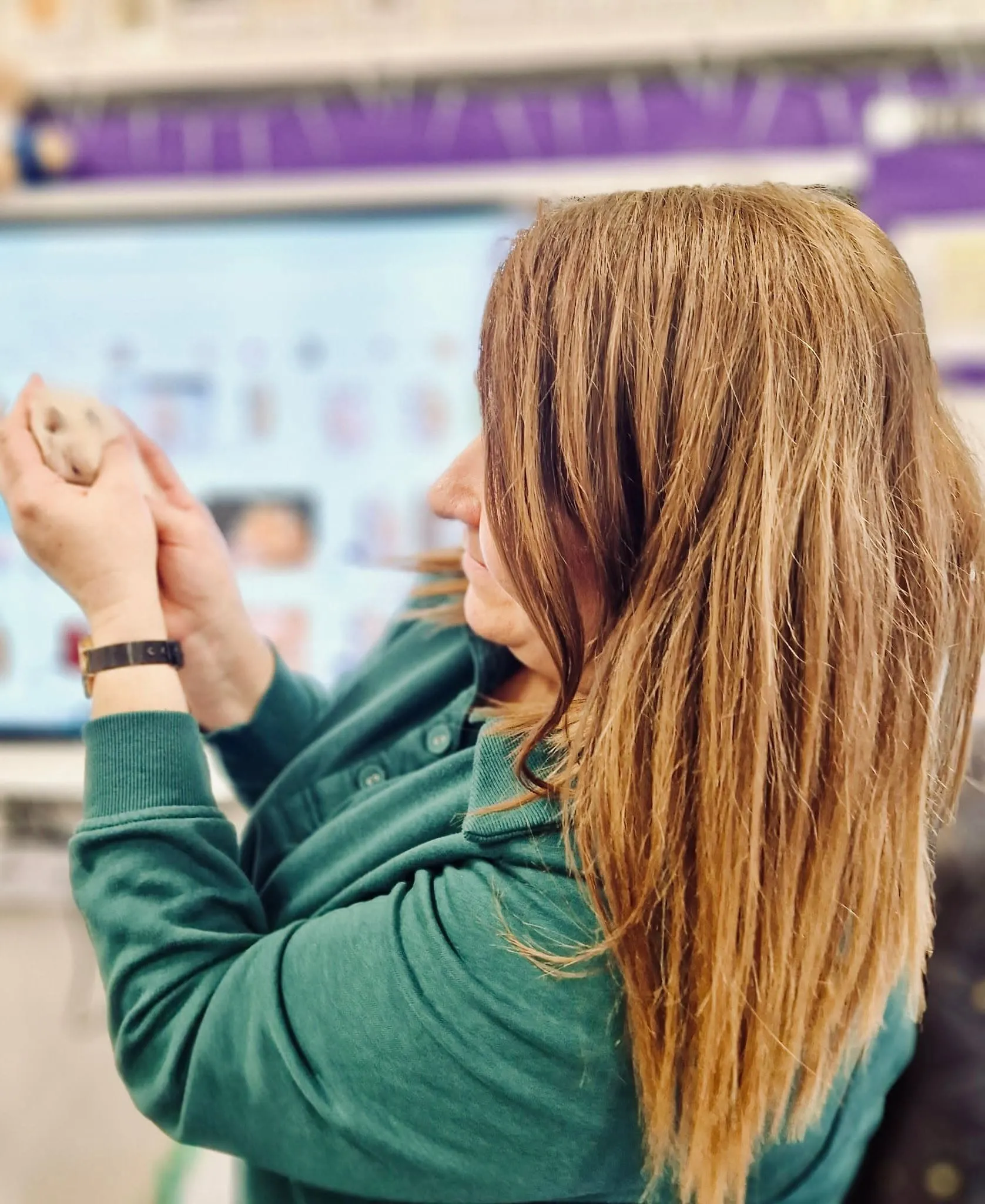



During one of our spelling lessons, an unusual guest appeared in the classroom: Coco the hamster – a small, fluffy ball of fur who helped the pupils understand the spelling rules for the digraph ‘ch’. It would be hard to find a better helper: the word ‘chomik’ (hamster) itself begins with this very digraph.
The children were able to look at the little animal up close and carefully hold it in their hands, and the teacher showed Coco to the whole class. An encounter like this sticks in the memory easily – and with it, the image of the correctly spelt word.
The digraph ‘ch’ is difficult for pupils because in the standard pronunciation of modern Polish it sounds exactly the same as ‘h’. The choice of spelling therefore depends on rules and visual memory. We write ‘ch’, among other cases, when it alternates with ‘sz’ in other forms of the word (mucha – musze, ucho – uszy), after the letter ‘s’ (schody, schować) and usually at the end of words (dach, orzech). Many words, such as ‘chleb’ (bread) or ‘chmura’ (cloud), simply have to be memorised.
For children growing up in Great Britain, this is a double challenge: in English, the letters ‘ch’ usually represent a sound close to the Polish ‘cz’, as in the word ‘chair’. That makes it all the more important for Polish spelling to be linked to a concrete, vivid experience.
As the report on the lesson put it, it would be hard to imagine a nicer day at school.